Campaign Brickwall Grid System

Why did we put up with hexagons when making Campaign maps? Mainly because wargamers preferred hexes over a square checkerboard grid, and so those of us who traditionally favored them at the beginning of D&D. We were wargamers and favored how one could move equidistantly in six directions. Moving diagonally with squares, one moves faster or has a complex system of Movement Points to compensate for the extra 50% distance moved diagonally.
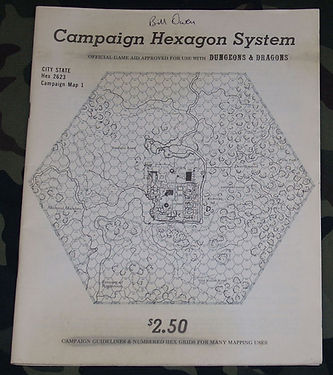
While at Judges Guild in 1977, I designed the Campaign Hexagon System for use with Dungeons & Dragons. Since then, I have realized several drawbacks to both campaign maps and the rescaled Campaign Hexagon System approach. Now's the time to fix them. If one offsets every other column of rectangles one makes, one has the equivalent of a hex grid! And a field of 10x10 such "bricks" fits nicely on a letter-sized piece of paper.
To see more details of this project, click on this post on my Wargame Campaign blog.


Bricked Baronies look better and are another PRO to the Brickwall system
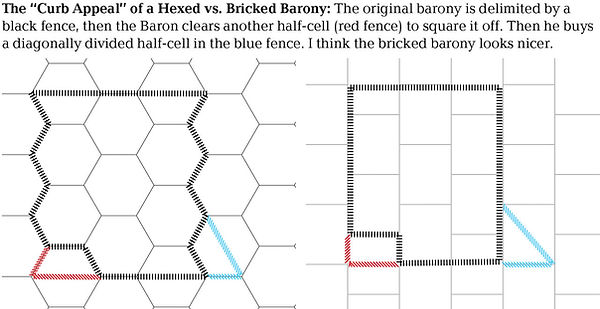
I most enjoyed the Barony-building aspect of D&D, and square-edged cells like the bricks look better than outlined hexagons. If one cleared an adjacent ‘cell’ (whether hexagon or brick) of a barony (or bought it from another ruler), then if one got half of a cell, it would look better than the “sunflower" look of seven hexagons where a half hex does not square off one's realm.